Technology
Conveyors for parcel handling and distribution centers: engineering, types and integration
A conveyor system carries boxes, totes, envelopes and poly bags in a steady flow between receiving, picking, packing and shipping. Kairos integrates and combines three key technologies: rollers (gravity, continuous drive or 24 V or 48 V MDR), flat belt and modular belt, along with curves and spirals. At Kairos we design new lines, and extend, retrofit and maintain your system anywhere in Mexico, whatever the brand.
What is a conveyor and what is it used for?
A conveyor is the electromechanical equipment that moves products between key processes inside a plant or distribution center. In an e-commerce distribution center, for example, conveyors move orders from picking to packing and from packing to shipping. Today they are the heart of production systems, keeping a steady flow of materials between work areas.
It is the technology that runs the most hours in a plant or distribution center. When a conveyor stops, the order stops and the delivery is at risk.
What are the types of conveyors?
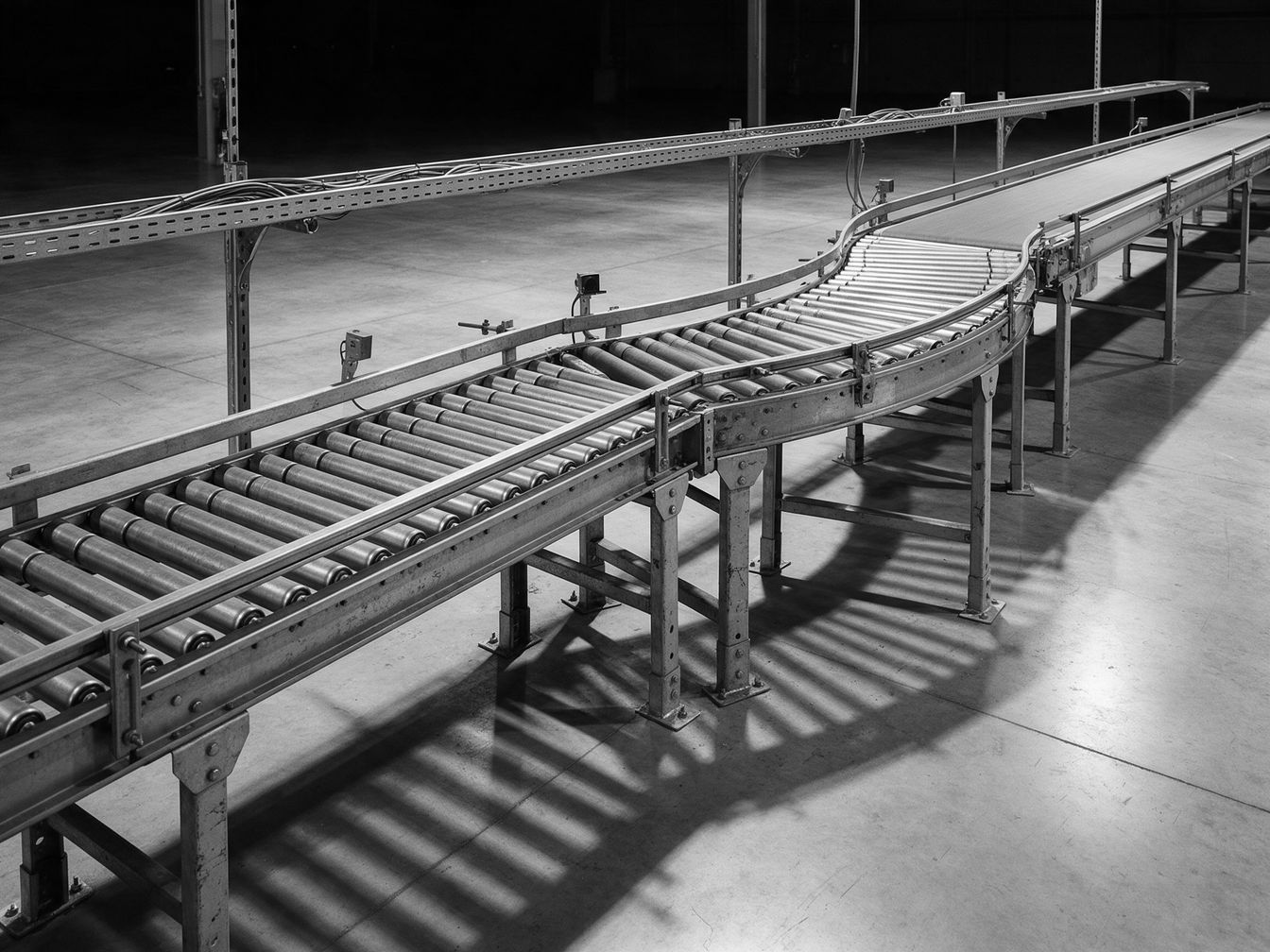
Parcel handling conveyors fall into three technologies according to their contact surface: belt, roller and modular belt. From them, transport systems are configured with curves, elevation changes, transfers and zero-pressure accumulation. The choice depends on the parcel’s shape and dimensions, its weight and the required flow per hour (throughput).
Belt conveyor
A continuous belt over a slider bed or a roller bed carries the parcel resting on its whole base. It is the technical answer for flexible products, irregular packaging, envelopes and poly bags. It is used for sorter induction, in-motion weighing, scanning, packing stations and to go up or down inclines and declines.
Roller conveyor
Rollers in a row driven by gravity, by a continuous drive (belt or chain) or by internal motorized rollers (24 V or 48 V MDR). They carry corrugated boxes and rigid totes. With MDR technology they allow zero-pressure accumulation (ZPA), on-demand start by zone and modular extensions with low power use and simplified wiring.
Modular belt conveyor
A belt assembled from hinged plastic modules and driven by sprockets, which eliminates the slipping and mistracking of conventional belts. It can combine straight and curved sections with a single gearmotor, making for tight transfers and module-by-module replacement. Kairos integrates this technology with a focus on parcels, boxes and distribution centers, and on food processing.
Variants and sections
| Type | What it is for | Where it is used |
|---|---|---|
| Gravity roller / skate wheel | Moving parcels by hand or on a slope, with no motor and no power use | Packing stations, inspection lines, trailer unloading, short sections |
| Zoned motorized roller (24 V or 48 V MDR) | Zero-pressure accumulation (ZPA) and on-demand start, with the motor built into the roller | Picking zones, dynamic buffers; allows growth in modules |
| Roller with central drive | Continuous transport of boxes and totes with one gearmotor per section | Long runs, links between processes and continuous induction |
| Flat belt | Moving a wide variety and volume of products: boxes, envelopes, plastic bags and irregular parcels | Sorter induction, in-motion weighing, scanning, packing and slopes |
| Telescopic and extendable conveyors | Reaching into the truck to load or unload floor-loaded freight ergonomically | Receiving (inbound) and shipping (outbound) docks for trailers and vans |
| Accumulation | Holding parcels in a queue without pushing or impacts until the next process calls for them | Ahead of packing, merges, sorters and palletizers |
| Curves | Changing direction while keeping the parcel’s alignment and orientation | Turns in the layout, corners, column clearance and returns |
| Merges and diverts | Joining several lines into one with metered spacing, or splitting the flow to another branch | Merging multilevel picking lines and exits to different packing lines |
| Spirals and lifts | Moving product up or down a level in the least floor space | Mezzanines, raised platforms and buildings with two or more levels |
| Transfer tables | Moving parcels from one line to another at 90° with pop-up wheels or belts | Crossings between parallel lines, returns and manual or semi-automatic sortation |
What are the parts of a conveyor?
A conveyor is made of a structure and supports (legs), rollers or a belt, gearmotors or motorized rollers, zone control cards, sensors and photo-eyes, side guides, bearings, tensioners and an electrical panel with emergency stops. Moving parts suffer the most continuous wear and need regular attention.
| Part | What it does | Typical wear |
|---|---|---|
| Structure and supports (legs) | Carries the load and sets alignment and level, giving the system rigidity | Forklift impacts, loose fasteners and uneven heights |
| Rollers and bearings | Support and rolling surface for the parcel | Bearing failure, shaft wear and dented tubes |
| Belt and splices | Continuous bed that pulls deformable parcels | Loss of tension, mistracking and cracks at splices or lacing |
| Transmission (Poly-V bands, O-rings or chains) | Transfers rotation between rollers or drive shafts | Stretching, drying out, breakage from friction and sprocket wear |
| Gearmotors and MDR rollers | Provide motion and travel speed | Overheating, lubricant leaks and gear wear |
| Zone control cards (MDR) | Run the start, stop and ZPA accumulation logic | Electronic failures from voltage spikes, overcurrent or loss of network communication |
| Sensors and photo-eyes | Detect the parcel’s position and presence | Lenses dirty with dust or lint, optical misalignment and broken brackets |
| Electrical cabinet and emergency stops | Power supply, PLC control and safety circuit | Burnt relays and contactors, loose contacts and damaged buttons |
Motorized rollers (MDR) or a belt conveyor with a central drive?
Zoned motorized rollers (24 V or 48 V MDR) are the best option for processes that need accumulation, on-demand starts and modular lines that have to grow in phases. A belt conveyor with a central drive is ideal for long runs, continuous transport and handling a wide variety of products (boxes, envelopes and bags). The choice depends on how your flow behaves and on your budget.
| Decision criterion | Zoned motorized rollers (MDR) | Belt conveyor with central drive |
|---|---|---|
| Product variety / parcel type | Corrugated boxes, rigid totes and parcels with a firm base | A wide variety of products: boxes of every size, envelopes, bags and soft packaging |
| Parcel accumulation | Built in (ZPA): holds product zone by zone with no contact or damage | Limited: transport is continuous; it needs mechanical stops or sectioned belts to accumulate |
| Power use | On demand: each zone switches on and off only as the parcel passes | Continuous: the gearmotor runs at a constant rate while the line is active |
| Line extension | High: plug & play modules are added without recalculating total power | Requires checking motor power, belt tension and reducer capacity |
| Maintenance on site | Quick replacement of rollers or cards by zone; less mechanical wear | Robust, well-known mechanics (gearmotor, pulleys and belts), with no electronic cards in the bed |
| Cost per linear meter | Higher initial investment in electronic and control components | Lower initial investment on long transport-only runs |
What are the most common failures in a roller conveyor?
On a parcel or distribution center line, failures almost never give days of warning; they tend to show up in the middle of peak operation. Knowing the critical points lets you act before the line stops.
- Jams at transfers and curves: parcels that get stuck because of misaligned guides or abrupt speed changes.
- Belts mistracking or slipping: loss of tension, worn pulleys or built-up dirt that causes lateral drift.
- Failed motorized rollers or cards: overheating from excessive accumulation or electrical damage to zone cards.
- Dirty or out-of-adjustment sensors: photo-eyes covered in cardboard dust or knocked out of alignment, causing false readings or phantom stops.
- Mechanical noise and vibration: seized bearings, unlubricated pillow blocks or unbalanced shafts.
What is evaluated before working on a conveyor?
Before working on a line, the critical operating conditions are evaluated on the floor:
- Equipment dimensions: belt width, length per section, elevations and clear heights in the building.
- Load and parcel type: weight, extreme dimensions, packaging material and stability in transit.
- Capacity and flow: line speed and pieces per hour in standard operation and at peak season.
- Controls and electromechanics: condition of gearmotors or MDR rollers, sensors, cards and panels.
- Operational shutdown window: the maximum hours the line can stop without holding up shipping.
How it is done: site survey and specification. How downtime hours are planned: shutdown window checklist.
What Kairos does with this technology
- Design and integration of new lines: complete belt, roller and modular belt lines adapted to your flow: new system design.
- Work on existing lines: changes in phases so operations don’t stop: relocation, modification and extension, retrofit and dismantling and removal.
- Installation and commissioning: mechanical and electrical installation and start-up of conveyors bought from third parties or OEM manufacturers: installation and commissioning.
- Maintenance and supply: preventive service agreements and critical spare parts: maintenance and support, conveyor spare parts and plug & play conveyors.
In mechanics, electrical and controls we integrate whatever the brand; on proprietary control platforms we coordinate with the manufacturer or clearly define the scope before we start.
- Complementary technologies: WCS and WES software, mobile robotics (AMR and AGV) and sorters.
- Main applications: e-commerce, parcel sorting systems, packaging and palletizing and material handling in manufacturing.
How it fits in the whole system: the five material handling technologies.
Frequently asked questions
Frequently asked questions
Does Kairos manufacture conveyors?
No. Kairos is neither a manufacturer nor a brand distributor: it specifies the equipment that solves your operation, integrates it and answers for the system.
Can a conveyor of one brand be extended with sections of another?
Yes, if the site survey confirms compatible usable width, height, speed and controls. On proprietary controls, Kairos works with the manufacturer or tells you beforehand how far it can go.
Should a line be retrofitted or replaced?
It depends on the condition of the structure and how much the flow has changed. It is measured before deciding; the criteria are on the conveyor retrofit page.
Related services
- New system design: conveyors, sorters, racks, mobile robotics and software
- Relocation of conveyors, sorters, racks and mobile robotics: in phases
- Modification and extension of conveyors, sorters, racks and mobile robotics
- Retrofit and rehabilitation of conveyors, sorters, racks and mobile robotics
- Dismantling of conveyors, sorters, racks and mobile robotics: orderly teardown
- Maintenance and support for conveyors, sorters, racks and mobile robotics
- Installation and commissioning of conveyors, sorters, racks and mobile robotics
- Site survey and specification for conveyors, sorters, racks and mobile robotics
Can’t the operation wait?
Tell us what equipment you have, where it is and what your window is. We reply within one business day.
Hours: Monday to Friday, 9:00 to 17:00 (Monterrey time)